Associate Dentist vs. Practice Owner: Who Really Makes More?
For many dentists, ownership is still treated like the obvious financial next step.
Work as an associate. Build your skills. Buy a practice. Make more money.
But for a successful associate who is already earning a strong income, the decision is not that simple.
The better question is:
Can ownership create enough additional income, equity, and long-term upside to justify leaving a strong associate position?
A real-world example shows why that question is more complicated than comparing salaries.
A real-world associate-to-owner comparison
Consider a currently practicing associate dentist producing approximately $80,000 per month.
The associate is paid 35% of adjusted production and receives about $51,000 per year in employer-paid benefits.
That produces:
- Associate cash income: $336,000 per year
- Employer-paid benefits: $51,000 per year
- Total compensation package: $387,000 per year
This is already a very strong associate opportunity.
Now model that dentist purchasing a practice.
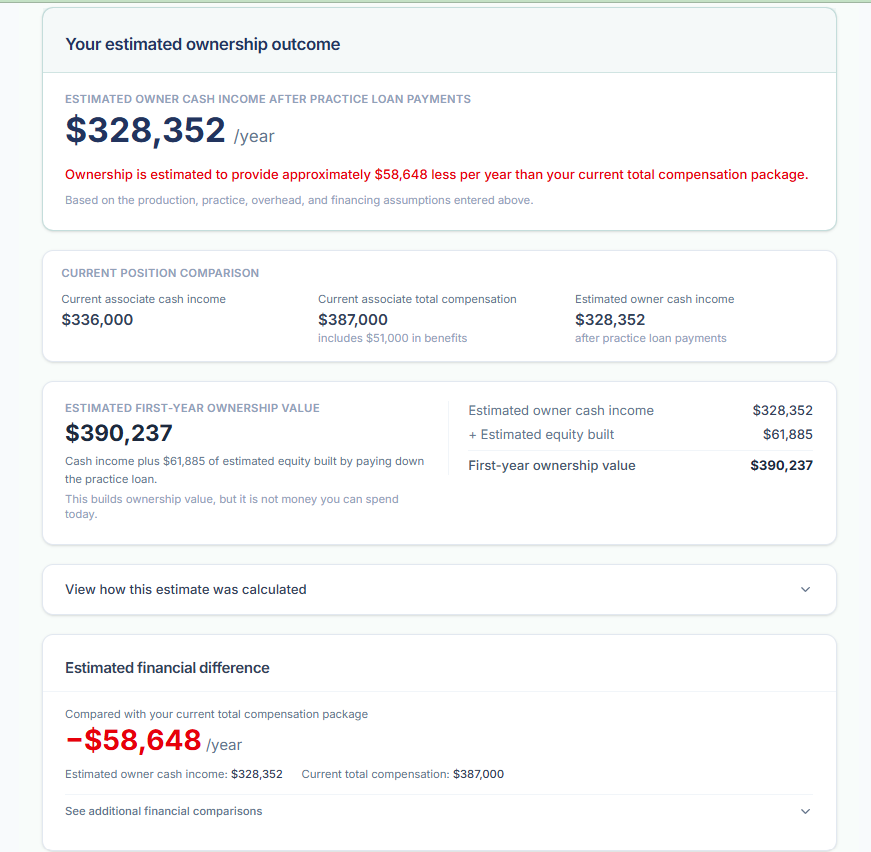
Using realistic assumptions for practice overhead, financing, hygiene support, and acquisition cost, the Dental Tool Lab Associate-to-Owner Income Calculator estimates owner cash income after the practice loan payment at:
$328,352 per year
That is approximately $58,648 less per year than the associate's current total compensation package.
At first glance, ownership loses.
And that is precisely why the traditional advice that dentists should buy practices simply because "owners make more" is not very useful.
For a highly compensated associate, ownership may initially reduce spendable income.
But cash income is only one part of the ownership equation.
Cash income and ownership value are not the same thing
The first-year comparison reveals one of the most important differences between associateship and ownership.
The associate receives more compensation that can be spent or invested immediately.
The owner receives less cash—but part of each acquisition-loan payment is also reducing principal and building equity in the practice.
In this example:
- Estimated owner cash income: $328,352
- Estimated practice-loan principal paid in year one: $61,885
- Estimated first-year cash income plus equity built: $390,237
Estimated first-year ownership value: $390,237 vs. $387,000 associate package
That estimated first-year ownership value is slightly higher than the associate's total compensation package — but only because it includes $61,885 of equity built by paying down the practice loan. That equity is not spendable income.
That estimated first-year ownership value is slightly higher than the associate's $387,000 total compensation package.
But there is an important distinction.
$61,885 of equity is not $61,885 of spendable income.
For lifestyle and cash-flow purposes, the associate remains ahead. For long-term net worth, the comparison is already much closer.
For lifestyle and cash-flow purposes, the associate remains ahead.
For long-term net worth, the comparison is already much closer. That difference becomes more meaningful over time.
What happens after five years?
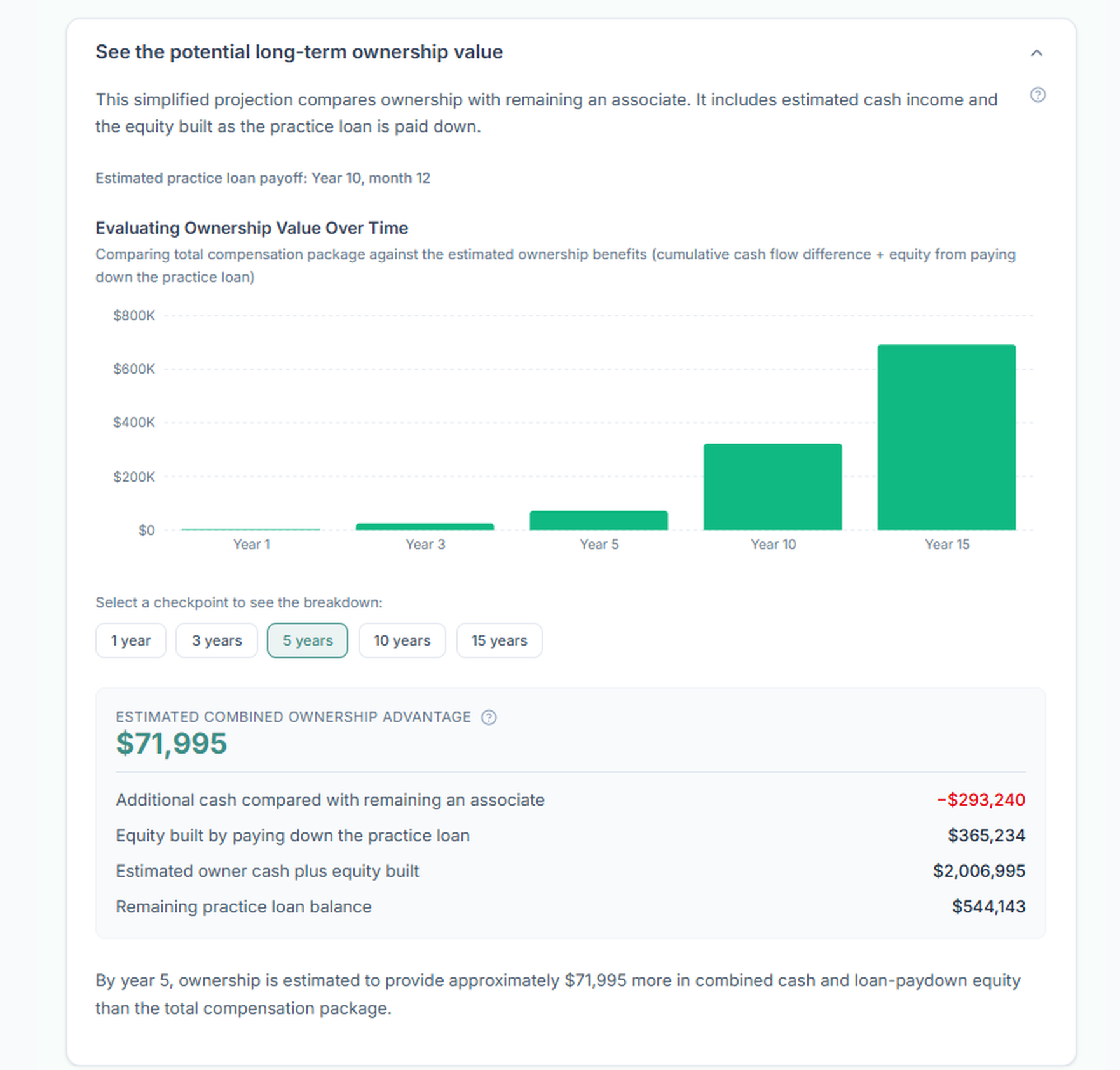
If the same assumptions continue, the model estimates that by year five:
- The owner has received approximately $293,240 less cumulative cash than the associate.
- The owner has built approximately $365,234 of equity by paying down the practice loan.
- The resulting estimated combined ownership advantage is approximately $71,995.
In other words, the associate has received more usable income during those five years.
But the owner has converted part of that cash-flow sacrifice into ownership of an asset.
Ownership did not win because the owner earned more every year. It won because the owner was converting some of the short-term cash disadvantage into equity.
That is a very different financial model than remaining an associate.
The picture changes again after the practice loan is paid off
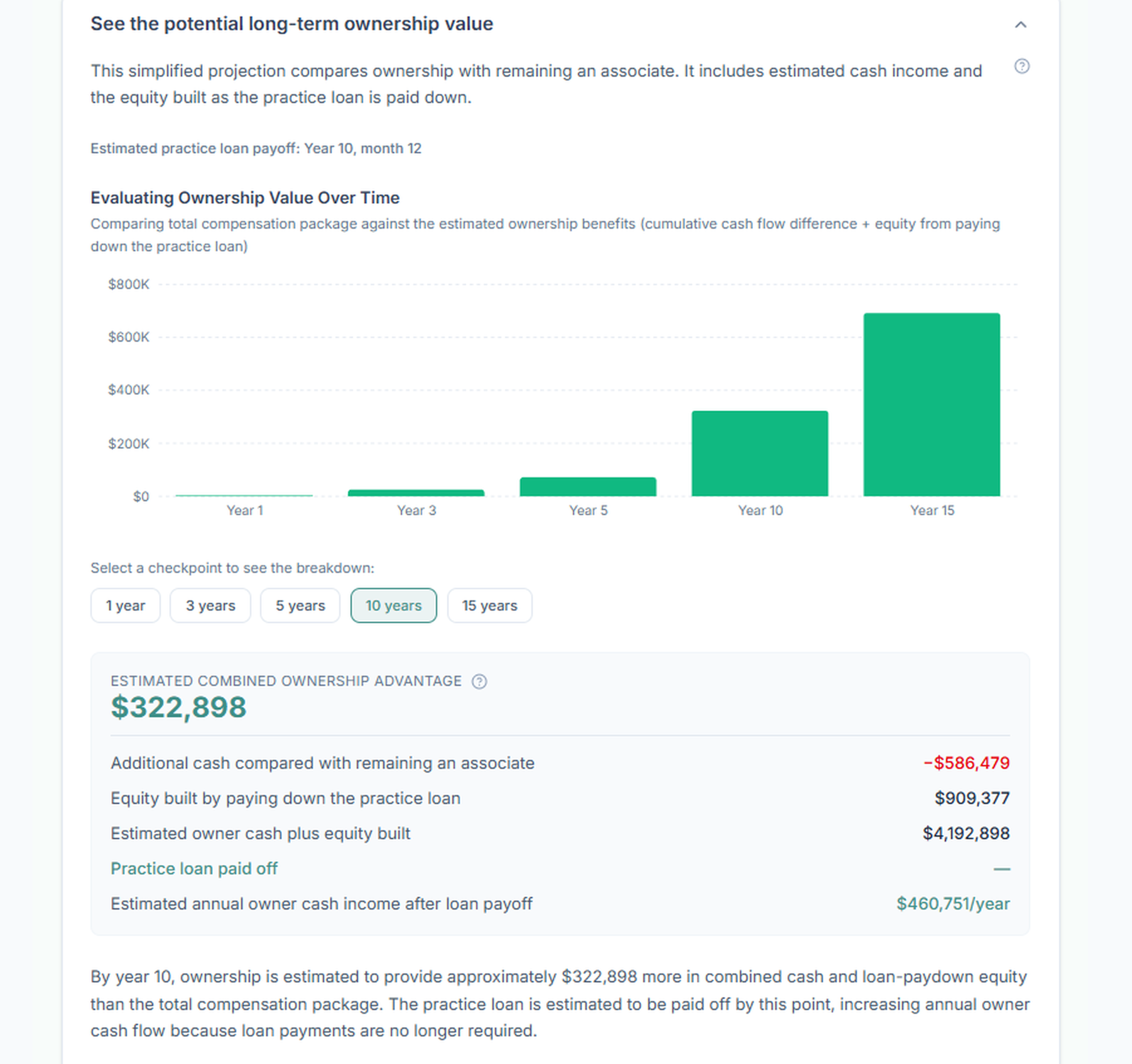
By year 10, the modeled practice acquisition loan is paid off.
At that point, the calculator estimates:
- Cumulative cash disadvantage compared with remaining an associate: −$586,479
- Equity built through loan paydown: $909,377
- Estimated combined ownership advantage: +$322,898
- Estimated annual owner cash income after loan payoff: $460,751 per year
This is where the economics change materially.
During the acquisition-loan period, the owner is sacrificing cash flow to service debt.
After the loan disappears, more of the practice's operating profit becomes available as owner income.
In this example, annual owner cash income rises from roughly $328,000 while servicing the practice loan to approximately $461,000 after the practice loan has been paid off.
That is about $74,000 per year more than the original $387,000 associate compensation package.
And this simplified model is only counting equity created through principal paydown. It does not assume that the practice itself appreciates in value.
The real ownership question is not "Who earns more?"
This example changes the question.
The important issue is not simply:
Do practice owners make more than associates?
A more useful question is:
How much current income should a successful associate be willing to give up in exchange for future ownership value?
For some dentists, the answer may be very little.
For others, accepting lower cash flow for several years may be reasonable if the underlying practice is strong and the long-term economics justify it. That is a personal and financial decision—not a universal rule.
National averages provide context, but they do not answer the decision
The American Dental Association Health Policy Institute's 2025 Survey of Dental Practice provides a useful national reference point.
Among general practitioners:
- Average owner income was approximately $228,980.
- Median owner income was approximately $199,140.
- Average employed-GP income was approximately $164,510.
- Median employed-GP income was approximately $165,520.
So owners earned more on average.
But those figures also demonstrate why national averages are insufficient for an individual ownership decision.
The associate in our real-world example already has a $387,000 total compensation package—well above the average income reported for either group.
Telling that dentist that owners make more "on average" adds very little.
The relevant comparison is:
Can the specific practice under consideration create enough sustainable cash flow, equity, and long-term upside to outperform the unusually strong associate opportunity being given up?
Source: ADA Health Policy Institute, 2025 Survey of Dental Practice.
Ownership income is different from associate compensation
An associate primarily earns income from performing dentistry.
The compensation package may include:
- production or collections compensation,
- bonuses,
- retirement contributions,
- health insurance,
- paid time off,
- continuing education,
- malpractice coverage,
- and other benefits.
Ownership has a different economic structure.
A practice owner may receive value from three separate places.
1. Compensation for clinical dentistry
The owner still performs dentistry and produces revenue. Part of the economic return is therefore compensation for the owner's own clinical work.
2. Business profit
After the costs of operating the practice are paid, the remaining business profit belongs to the owner. That is one of the fundamental financial advantages of ownership.
3. Equity
As acquisition debt is paid down, the owner builds equity in the practice. Over time, that equity may become a valuable asset that can potentially be sold.
A salary comparison captures the first category. It can completely miss the other two.
Practice revenue is not owner income
When evaluating a practice purchase, it is easy to focus on collections.
But collections are only the starting point.
The ADA reported average 2025 gross billings of approximately $965,660 per dentist among GP owners, while solo GP owners averaged about $1.06 million.
Those numbers do not represent owner take-home income.
The practice still has to pay its operating expenses.
Cain Watters' 2024 accounting-client data showed its average one-doctor general practice collecting about $1.41 million, with reported overhead of approximately 61.5% before non-operating and doctor costs.
PKF O'Connor Davies similarly reported operating overhead before dentist compensation of roughly 60% to 66% across different general-practice revenue bands in its client dataset.
The exact percentages vary by practice and accounting conventions.
But the principle is simple: the owner does not keep collections. The owner receives what remains after the business operates and its obligations are paid.
Sources: ADA Health Policy Institute, 2025 Survey of Dental Practice; Cain Watters, 2024 Dental Practice Comparison (accounting-client sample, not national average); PKF O'Connor Davies / Academy of Dental CPAs, 2025 Dental Practices by the Numbers (accounting-client sample, not national average).
What actually makes up dental practice overhead?
An associate considering ownership may understand the concept of overhead without ever having needed to examine its components closely.
That changes when evaluating a purchase.
In Cain Watters' one-doctor general-practice client sample, some of the larger reported categories were approximately:
- 26% for team payroll and payroll taxes
- 7% for clinical supplies
- 6% for laboratory expenses
- roughly 6% for rent and basic utilities
- plus accounting, insurance, merchant fees, marketing, office expenses, continuing education, repairs, and other costs
PKF's general-practice client data similarly showed total staff compensation around 27% to 29% of receipts across its revenue bands.
The key lesson is not that every practice should hit one exact overhead percentage.
It is that relatively small differences in operating costs can have a very large effect on owner income.
Consider a practice collecting $1 million:
- 58% operating overhead leaves $420,000 before applicable owner-specific costs.
- 65% operating overhead leaves $350,000.
- 70% operating overhead leaves $300,000.
A 12-percentage-point difference represents $120,000 per year. For an associate already earning $300,000 to $400,000, that difference may determine whether ownership improves or worsens the financial picture.
A high-income associate has a much higher ownership hurdle
This is one of the most important parts of the comparison.
If an associate earns $165,000 and purchases a practice capable of sustainably generating $300,000 or $350,000 of owner income, ownership may create a substantial financial improvement.
But the decision looks very different for someone already earning $300,000, $350,000, or more.
That dentist is not choosing between ownership and an average associate job.
They are giving up an unusually valuable alternative.
The practice therefore needs to compensate them for accepting:
- acquisition debt,
- staffing responsibility,
- payroll risk,
- management time,
- equipment and facility obligations,
- operational uncertainty,
- and the possibility that the seller's historical economics will not transfer perfectly after the sale.
The stronger your current associate position, the more selective you can afford to be.
How much more production would it take to match the associate position?
The real-world calculator example provides another useful perspective.
With current owner production modeled at approximately $80,000 per month, estimated owner cash income after acquisition debt is about $328,000 per year.
To match the existing $387,000 total associate compensation package through current owner cash income, the model estimates that owner-doctor production would need to rise to approximately:
$98,416 per month
That is roughly $18,400 more per month, or about a 23% increase in owner production.
A 23% increase in owner production turns a vague growth assumption into a concrete question.
Is a 23% increase in owner production realistic in this particular practice? Does the schedule have capacity? Are there enough new patients? Is treatment being referred out that can confidently be brought in-house?
This turns a vague idea like "I'll grow the practice after I buy it" into a much more practical question:
- Does the schedule have capacity?
- Are there enough new patients?
- Is treatment being referred out that you can confidently bring in-house?
- Can fees improve?
- Is hygiene supporting enough treatment?
- Does the practice have enough operatories, staff, and demand?
Those are exactly the kinds of questions that should be answered before using future growth to justify a purchase.
Owners also work more
Income is not the only consideration.
ADA trend data found that owner dentists worked approximately 2.5 more hours per week than employee dentists in 2025.
Those hours may include responsibilities that never appear on a production report:
- hiring,
- staffing problems,
- payroll,
- vendor decisions,
- facility issues,
- insurance,
- financial review,
- leadership,
- compliance,
- and strategic planning.
Some dentists value those responsibilities because they also provide autonomy and control.
Others may reasonably decide that a highly compensated associate position with fewer administrative obligations is more attractive. Ownership should compensate you not only for capital risk, but also for taking responsibility for the business.
Source: ADA Health Policy Institute, 2026 Trends in Dentists' Income, Revenue, and Hours Worked.
Associate benefits also belong in the comparison
A common mistake is comparing owner income with associate cash compensation while ignoring employer-paid benefits.
DentalPost's 2026 Salary Survey found that among associate dentists:
- 47% reported retirement benefits,
- 46% reported medical benefits,
- 44% reported dental benefits,
- and 28% reported receiving no employee benefits.
Those numbers show how different associate compensation packages can be.
An associate earning $300,000 plus strong retirement contributions, insurance, paid CE, malpractice coverage, and paid time off may have a substantially more valuable position than another dentist earning the same salary without those benefits.
That value should be included in any legitimate ownership comparison.
In the real-world example above, employer-paid benefits add approximately $51,000 to the associate's annual compensation package.
Ignoring them would make ownership appear much more attractive than it really is.
Source: DentalPost, 2026 Dental Salary Survey (dentist sample includes owners and associates; associate-specific benefit findings used separately).
So when does ownership become financially compelling?
There is no single rule, but I would look for four characteristics.
Meaningful profit beyond your own clinical production
If ownership merely replaces the income you already earn as an associate while adding debt and responsibility, the financial case may be weak. Ideally, the business generates profit beyond reasonable compensation for your own dentistry.
Transferable practice economics
The practice's historical performance has to survive the transition from seller to buyer.
That means considering:
- patient retention,
- staff retention,
- payer mix,
- seller procedure mix,
- hygiene,
- fees,
- facility costs,
- collections,
- and future capital needs.
Realistic growth opportunities
A good practice may become materially better if there are credible opportunities to improve:
- case acceptance,
- patient flow,
- collections,
- fees,
- hygiene,
- scheduling,
- procedures offered,
- or clinical capacity.
But future growth should strengthen a good purchase—not rescue a bad one.
Equity worth building
A practice may still be attractive even if annual cash flow initially trails a great associate position. But the equity being built should be meaningful enough to justify the tradeoff.
Equity is part of the return. It should not be used to excuse weak operating economics.
Bigger does not automatically mean better
It is tempting to assume larger practices automatically produce better economics.
Some benchmark data suggest scale can help. Cain Watters' general-practice client data showed reported overhead declining from approximately 61.5% for one-doctor practices to roughly 54% for three- and four-plus-doctor practices, with lower administrative costs contributing substantially to the difference.
But the relationship is not universal. PKF's highest-revenue general-practice band showed operating overhead around 65.5%, higher than the middle revenue band in its dataset.
Larger practices can also require:
- more staffing,
- more management,
- more operatories,
- additional equipment,
- more technology,
- and more organizational complexity.
The goal is therefore not maximum revenue. It is profitable revenue.
Practice economics have become more challenging
Recent ADA data provide another reason to model ownership carefully rather than relying on historical assumptions.
Comparing pooled 2016–2020 with 2021–2025 on an inflation-adjusted basis:
- GP revenue per dentist increased about 1.4%,
- expenses per dentist increased about 4.9%,
- and GP income declined about 8.1%.
Expenses have been rising faster than revenue.
That means increasing production alone does not guarantee increasing owner income. The economics of the practice matter.
Source: ADA Health Policy Institute, 2026 Trends in Dentists' Income, Revenue, and Hours Worked.
The ownership tradeoff
For an associate evaluating ownership, the decision can often be simplified conceptually like this:
Staying an associate
- ✓ More predictable current cash income
- ✓ Employer-paid benefits
- ✓ No acquisition debt
- ✓ Less business risk
- ✓ Less administrative responsibility
- ✗ No practice equity
Buying a practice
- ✗ Potentially lower cash income while servicing debt
- ✗ Greater operational responsibility
- ✗ Greater financial risk
- ✓ Business profit
- ✓ Loan principal paydown
- ✓ Practice equity
- ✓ Potentially much higher income after debt is retired
- ✓ More control over the future of the practice
Neither side automatically wins.
The question is whether the specific ownership opportunity provides enough value to justify the trade.
So who really makes more?
Nationally, practice owners still earn more than employed general dentists on average.
But averages are almost irrelevant when making an actual career decision.
For the associate in our example, the current position provides approximately $387,000 in annual total compensation.
The modeled owner initially receives only about $328,000 in annual cash income.
After five years, ownership moves ahead only after including the equity created through loan paydown.
After ten years, the combined ownership advantage grows to more than $320,000, and estimated annual owner cash income rises above $460,000 once the acquisition loan disappears.
So which path is better?
There is no universal answer.
The real question is: Does the income, equity, control, and long-term upside of this specific practice justify giving up the associate opportunity you already have?
That is a much higher-quality question than asking whether owners generally make more.
Start with your actual numbers
If you are considering ownership, the first step should be comparing your current associate compensation with a realistic ownership scenario.
The Dental Tool Lab Associate-to-Owner Income Calculator is designed to help you compare:
- associate cash income,
- employer-paid benefits,
- practice collections,
- operating overhead,
- acquisition debt,
- estimated owner cash income,
- and the potential long-term value created through practice-loan paydown.
If ownership still looks attractive, the next question becomes much more specific:
Is the practice you are considering actually a good practice to buy?
That requires stress-testing patient retention, seller transition, staffing, facility expenses, fees, collections, financing, immediate investments, and other changes that may occur after the purchase.
The Dental Tool Lab Practice Purchase Analyzer helps you model how changes in patient retention, staffing, fees, operating expenses, financing, immediate investments, and other transition assumptions may affect the practice after purchase.
Analyze a Practice Purchase
Stress-test a specific acquisition — patient retention, staffing, fees, expenses, financing, and other transition assumptions — to see how they affect owner income after the purchase.
Final takeaway
Practice ownership is not automatically the financially superior career path.
Neither is staying an associate.
A highly compensated associate may have an unusually valuable position.
A well-run practice may offer substantially more long-term income, equity, autonomy, and control.
A weak practice can create more debt, more responsibility, and less income.
The mistake is deciding that ownership is better before analyzing the opportunity.
Ownership should not be the goal simply because it is the traditional next step.
The goal is recognizing when the right practice creates an opportunity that is genuinely better than the one you already have.
For a deeper look at evaluating the associate opportunity you are currently in or considering, see How to Evaluate a Dental Associate Opportunity and How to Evaluate the Real Income Potential of a Dental Associate Job.
To compare associate offers side by side, use the Dental Associate Compensation Calculator.
This article provides general educational information and is not legal, financial, tax, accounting, or investment advice. The real-world example used throughout is anonymized and does not identify any individual. National benchmark figures are sourced from published third-party surveys and accounting-firm client datasets; they represent samples rather than universal norms. Consult qualified legal, financial, and dental business advisors before making practice acquisition decisions.
Stay Updated
Get notified when new guides, calculators, and resources are published.
By subscribing, you agree to receive Dental Tool Lab emails. You can unsubscribe at any time. See our Privacy Policy.
Road to Ownership
Continue Your Road to Ownership
Now that you've compared the economics, return to the Road to Ownership to continue evaluating whether a practice purchase makes sense for you.
Related Tools & Resources
Associate-to-Owner Income Calculator
Compare your current associate compensation against a realistic ownership scenario, including overhead, debt, and long-term equity.
How to Evaluate a Dental Associate Opportunity
Evaluate the practice, the position, and the written offer before committing.
How to Evaluate the Real Income Potential of a Dental Associate Job
Investigate the opportunity behind the offer and stress-test the production assumptions.
Dental Associate Compensation Calculator
Evaluate one associate offer or compare two opportunities side by side.
Practice Purchase Analyzer
Stress-test a specific dental practice acquisition by modeling transition assumptions, operating expenses, financing, and the changes that may affect owner income after purchase.
Should I Buy a Dental Practice or Stay an Associate?
Look beyond income and compare control, flexibility, responsibility, risk, location, and career goals before deciding whether ownership fits you.
When Are You Financially Ready to Buy a Dental Practice?
Once the economics make sense, understand whether your personal financial position — liquidity, debt, production history, and margin for error — is ready for a purchase.